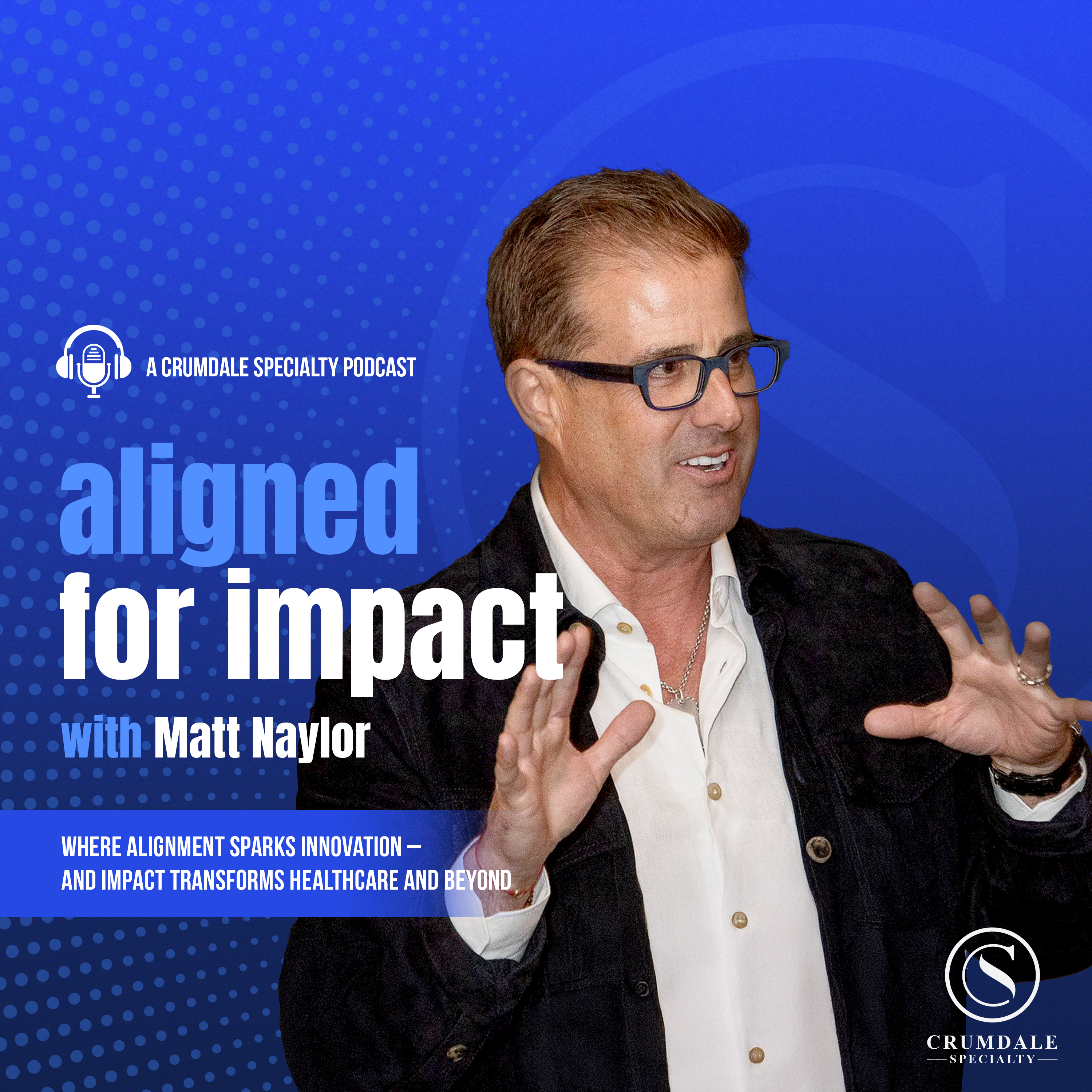
Episode Transcript
[00:00:02] Speaker A: Welcome to Alignment for Impact.
I'm your host, Matthew Naylor. I started this podcast because healthcare and leadership both come down to the same thing. Alignment. When people, purpose and performance connect, real impact happens.
On this show, we'll talk with entrepreneurs, brokers and change makers who are challenging what is broken in healthcare and in business and find new ways to make a difference for companies, communities and the people they serve.
I'm Matt Naylor. I'm the host of the Matthew Naylor podcast. We talk about insurance and healthcare. It's a really awesome conversation. Crumbdale sits at this awesome intersection of risk financing, employer health services, cost containment and technology.
You know, a lot of my interviews are not just about the intersection that Crumbdale sits at, but more importantly, it's about life, it's about innovation, it's about being creative, it's about being disruptive, it's about being an entrepreneur, it's about living a life with passion and purpose. It's about really having a positive impact.
I love starting these conversations with, like, just an easy icebreaker.
Jake and Brian, you guys are my founding partners here at Crumbdale Specialty.
Maybe Jake, we'll just start with you. Could you just tell us a little bit about yourself?
[00:01:32] Speaker B: Sure, Matt. Thanks for having me. I'm really excited to be here.
I think you've done, I don't know, a couple dozen of these and now it's the first time Brian and I get an opportunity to sit with you. So I feel pretty special about that.
I grew up in the Philadelphia area, went to a private school here called Malvern Prep, where I played a lot of different sports, continued my athletics into college where I was a Division 1 lacrosse player.
After college, I decided to move to New York City and work for my father in the insurance space. A little bit different than what Chromedale does on the A and H employee benefit side. It's a really niche part of the insurance space around structured settlements, you know, annuities, life insurance, helping to settle large personal injury lawsuits and medical malpractice lawsuits all over the country.
It was a great way to kind of hone my relationship building skills. My father and I worked with with a lot of different specialty insurers all over the country. And a big part of what I did on a day to day basis was develop and build relationships with claims adjusters that were trying to help settle these cases.
I did that for about seven years. Very successful. My dad's still in the business today. He's been in the business for almost 30 years.
You know, one of the One of the top guys in the business. But I knew at some point that I was going to have to kind of go a different direction and experience life out on my own without, you know, working with my father, who is my best friend still today, love him to death. And you guys spent a lot of time with him. He's a great guy, you know, and a great businessman. But, you know, I kind of hit a point in my career where I decided I need to do something different.
You know, my dad's best friend, kind of an uncle figure to me, was the one who introduced you and I met back in 2012.
He knew, kind of. He knows me very well. He knew what I was looking for. And the words were, hey, I knew this really awesome young entrepreneur that lives right down the street from your father that you need to know.
And that was when he connected you and I together, and we got an opportunity to meet each other and spent some time for about a year and a half getting to know each other both personally and professionally, and just saw lots of synergies with kind of where I was in my career and my life and what I wanted to do and what you had already done and accomplished, which is. Which is more than anyone can. Can really ask for in their career and what you wanted to do next, you know, and I still remember to this day what you said to me when I came on board back in the late summer 2014, was to be patient and to really allow us the opportunity to be thoughtful about our approach into the marketplace.
And then if we did that, we were going to be wildly successful. And, you know, we sit here almost 11 years later in a position of wild success. But, you know, I think we would all agree that even with the successes that we've had so far, that there's a lot to do, a lot more wood to chop, a lot more success to be had.
[00:04:37] Speaker A: Jake, thanks so much for sharing it. The early days at Crumbdale were a lot of fun for you, Brian and I. They were, you know, Brian, same similar thinking here. You know, there's just. Tell us a little bit about, like, how you ended up joining Grumdale and a little bit about where you were before Cromdale.
[00:04:59] Speaker C: Sure.
So I grew up in Paoli, where our office is today.
I'm the youngest of seven kids.
I'm the first person in my family to graduate from college. Not the only one, but the first one. Even though I was the youngest, I went to Malvern Prep, where Jake also went to high school.
It gave me a good opportunity to Change my own trajectory. Played three sports there, went to college, played sports there as well, and ultimately went to law school. Started my career as an M and a private equity venture capital lawyer. I worked for a large law firm based out of Philadelphia. Was doing really well there, but I knew I wanted something more than just documenting someone else's business transactions in my Life.
So in 2012, I, I took an opportunity to do something a little different and went to a high growth business locally that was in the oil and gas industry.
Had a really wild ride there, Learned a lot.
Before I did that. You and I had the opportunity to meet randomly through a mutual friend.
And similar to Jake's story, when we were chatting with that mutual friend down in Avalon and he didn't realize we didn't previously know each other, he looked at us and said, you two need to know each other.
And so I made sure to make that happen when we got back from Avalon and really got to learn about the health benefits business through getting to know you and your experiences. And as my ups and downs in the oil and gas business, which were great and ultimately got me out of.
[00:06:47] Speaker B: Being.
[00:06:50] Speaker C: In the big league law firm world, got me into something that was more entrepreneurial, got me into something that allowed me to utilize my skills and the things I like to do, but not necessarily in a productive environment and not necessarily in a collaborative culture that was aligned for success.
And then as we started to put a little bit of the building blocks together for Crumbdale and we started to talk about your vision and strategy for what that looked like for the next chapter in your career, it became more and more interesting to me. The idea of bringing innovation to a world that desperately needs it, but has been resistant to it or slow to.
[00:07:33] Speaker B: Adopt, it.
[00:07:36] Speaker C: Was really intriguing.
So as my time in the oil and gas business was coming to an end and Crumbdale was taking off, I jumped at the chance to get out of something that could have been okay for me, but move into something that I think was going to be a lot more beneficial for me both personally and professionally.
And that has proven out in spades.
And one of the things that's very different about Crumbdale from where I worked previously is our culture.
I think it's really important for people to work together as a team. And when you collaborate and truly work together, you can accomplish things that you otherwise couldn't accomplish on your own.
And I came from an environment where it was very political, a lot of bs, even in just the day to day operations of the business. A lot of politicking, a lot of maneuvering, a lot of shucking and jiving, a lot of taking credit for things that other people did, and a lot of positioning, and all of which were a total waste of time. And that company doesn't exist anymore.
And I think that's a big reason why.
And so, you know, here at Crumbdale, I've had the opportunity to do lots of different things, which I love.
You know, I think you've given me an opportunity to utilize my skills, expertise, and experience in a lot of different ways.
I obviously didn't come from the insurance world, so I still remember the first time I had a conference call with somebody from a tpa, and he kept saying, tpa, tpa, And I didn't even know what he meant.
But I've certainly learned a lot. I know what a TPA is today, and it's been a great experience, both personally and professionally, working with you, Matt, and you, Jake, all these years.
[00:09:33] Speaker A: Now, the early days at Crumdale, you know, we.
I, with your help, focused on leadership, alignment and culture. And Brian, you just touched on culture a little bit. But, you know, we're going to talk today about innovation. We're going to talk about being creative and disruptive, and all those things matter as an entrepreneur when you want to make a big impact. But leadership and culture is a.
A really interesting thing. And I like to get both of your perspectives on our operating approach to leadership and culture and how you've made Crumbdale Specialty a unique business for a growing and thriving team. I remember the early days when we started the business and there was three of us and then four of us. And small businesses have small issues and small opportunities. Big businesses have bigger issues and bigger opportunities.
Can you just both, from your perspectives, just talk about leadership a little bit and talk about culture and how you, as leaders and culture builders, have built Grumdale into a very, very special business.
[00:10:53] Speaker B: Great. Sure.
[00:10:54] Speaker C: Dominique, I'll go first.
[00:10:55] Speaker A: Good.
[00:10:58] Speaker C: You know, I think about. You tell this story all the time. When we first started, there was no task too big or too small for us, you know, and we took out the trash, we moved the furniture, we set up, you know, the meeting room such that it was back then, you know, we did everything. We were truly chief cook and bottle washer.
And I think that, you know, while things are different and we have a much larger team of people, that ethos is the same. And I think it's leadership from the front, not the back.
I think for me Personally, I'm available 247 and if people need my help to do anything that needs to be done in order to advance what we're trying to execute, I'm ready to dive in and do it and collaborate with people and partner with them and be a real resource.
Not somebody who's, you know, barking orders or laying down expectations, but somebody who's really going to partner with people to figure it out and make sure it's moving forward. And you know, we talk a lot about our business. The unique thing is execution.
You know, we are innovative, we are creative and we'll get to a lot of those things, I'm sure. But execution is key to our success. And I think making sure that leadership and the way the three of us conduct ourselves, where we're partnering with the people who are on the front lines of that execution and making sure that we are collaborating and really working with them, I think helps set the tone in a lot of ways for our culture.
[00:12:37] Speaker A: And Jake, we speak a lot about alignment and we also talk a lot about details and discipline and accountability.
When you think of culture and leadership, how does that.
Because Chromedale has a vibe.
How does that show up every day for you as a, as a leader here at Chromedale?
[00:13:00] Speaker B: I think leadership and culture first starts with the people.
And I think the three of us have done a phenomenal job of hiring and recruiting and retaining the best of the best, whether they came from the industry or they haven't come from the industry.
We have incredible people. And I know it kind of starts and stops with people. And I know, Matt, like we just had this awesome two days here with our management team where we're driving AI and technology and I'm kind of bringing us back to like people first because I think again it starts and stops with the people. I think the AI and the technology that we, we build around our business is super important. But if we don't have the right people sitting side by side with us, we're not going to be able to execute to Brian's point on really any of our vision and strategy here at Crumbdale.
[00:13:43] Speaker A: And Jake, from your perspective, we talk about emotional well being. When we think about our culture, when we think about alignment from an emotional perspective, we think about it from an intellectual perspective and we think about it from a financial perspective. Can you tell us how you and Brian as leaders have implemented that strategy to create the culture and the vibe that we here have at Crumbdale?
[00:14:10] Speaker B: Yeah, definitely. I mean, listen, I think again, the three of us have really good instincts when it comes to all Three of those kind of puzzle pieces.
You know, we have these great people because they're intellectually stimulated. Being here at Crumdale, we're driving innovation. We're constantly changing. It isn't showing up and doing the same thing every single day.
Emotionally, we are culture first, we're family first. It's evident in all the things that we do for our teammates here at Crumdale, all the things that we invest in, all the charity work that we do. And then financially, I mean, maybe it starts with financial, maybe it doesn't for some people, but that's important as well. We gotta make sure that people can survive and live and feed their families and feel good about where they are from that perspective.
And I think, you know, I'm not going to say it's easy.
I think it's easier for us to understand those three component pieces for an individual teammate as we recruit them and bring them on. And I think we do a really good job of finding that alignment to make sure that, you know, they're going to feel really good about being here at Crumdale, accessing those three pillars. But I think the hard part comes in afterwards. What happens 6 months, 12 months, 18 months down the road where things change, people's perspectives change, life changes, the economy changes. And I think our ability to constantly check in with folks and use our emotional intelligence to understand where people stand in that journey and maybe what they might need. It might be a little emotional support, it might be a little intellectual support like, hey, help me on this project, or it could be financial.
And there's lots of things that happen on a day to day basis. And you know, again, I think Crumbdale is a great spot where, you know, we understand what's happening because we're tuned into our teammates and we're able to adjust fire and we're able to accommodate and meet people where they are and make sure that people that are part of this family continue to feel like they're part of this family and continue to grow in this family.
[00:16:09] Speaker A: You know, Brian and Jake, when you're a high performing organization like Crumdale Specialty, you know, we were, Inc. Magazine's, you know, top 125 fastest growing 5,000 companies in the United States in 2021. And we've been in Inc. Magazine every year, year over year for like the last seven years. We are Inc. Magazine's best places to work. Philly Business Journal. These, these accolades are all wonderful things, but they don't happen by accident. And when I think about culture and leadership you know, it's also holding people accountable. It's about having fair and firm conversations with people. Can you just talk about a little bit about your leadership approach to having honest and sincere conversations with people where you're motivating and coaching and leading and inspiring people to do great things and in challenging them in a fair way?
[00:16:59] Speaker B: Yeah.
[00:17:00] Speaker C: So from an inspirational perspective, and Jake touched on this a little bit, I mean, we have so many people who are team members that have great experience and expertise, and I think we do a really good job of leveraging. It sounds like a terrible way to put it, but making sure that people have the opportunity to contribute that experience and expertise to the problems that we're trying to solve and the things that we're trying to accomplish. And so from an engagement perspective, I think that we do a really good job of getting people engaged because we're putting them in a position where they have an opportunity to meaningfully contribute to what we're doing.
And I think that's rewarding for people.
From an accountability perspective, obviously, we've got an institutionalized process here that I think is pretty unique, and it's very intentional and detailed and deliberate, and I think that's really helpful from an accountability perspective. But I also think we have relationships with people where we're giving real time feedback constantly.
You know, when we have our quarterly review meetings, I always tell people if there was anything negative that was about to come out of my mouth, you'd already have heard it.
You know, because we work in real time, we. We give feedback in real time, we pivot in real time, we collaborate in real time. And so from an accountability perspective, I think a thing we do very well is making sure that people have that kind of real time feedback so that they can be better and they can understand if they've gotten off the rails a little bit, how to get back on them at the earliest possible time. So I think that's a big piece of making sure that from a leadership perspective, we're bringing accountability, but at the same time doing it in a way that's positive and collaborative.
[00:18:57] Speaker A: Great.
Let's pivot to impact.
You know, impact matters with leadership and culture, and I love to get some real examples from the two of you on how impact has shown up here for our team and our teammates and what you've done as leaders with the culture to provide real impact for individuals.
[00:19:23] Speaker C: So I think we do.
I think we're very thoughtful about how, you know, we've talked a lot about people and the level of expertise and experience that our team has.
And I think we do a good job and are very thoughtful about how we position those people in a way where they can be successful in ways they necessarily haven't necessarily been in the past.
You know, and the flip side of that is I think we're good at pushing people out of their comfort zone.
[00:19:54] Speaker B: Right.
[00:19:55] Speaker C: And so, you know, our chief revenue officer is a great example. Somebody who came from outside of the insurance industry, like myself, who accomplished a lot in his early to mid career, joined us looking for an opportunity to do something unique and different. And I think we supplied that opportunity in a lot of different ways. And not in a way where somebody's out on their own and it's sink or swim, but in a way where we're being collaborative and we're working together and we're supporting that individual so that they can take their game to the next level. And the more we can do that amongst ourselves, the more that we can do that with the team members that are at Crumbdale, the more that we can do that with the people who join Crumbdale in the future, the more successful we'll be. We always talk about one plus one equals three, and this is a big piece of it. How do we recruit talented individuals into the organization and then empower them to do things and give them responsibilities that they may not have had in the past, but they have the capacity, the capability and the desire to do more in their career? And how do we create an ecosystem where that's the vibe and how do we support that? And I think we do a really good job of finding talented people who want to take their game to the next level and creating a set of circumstances where we partner with them on that journey.
[00:21:29] Speaker B: Yeah, I think it's, you know, the old saying, leave it better than you found it.
I'm not sure they, you know, made that saying about people, but I kind of correlated a little bit.
Our retention on teammates is probably in the high 90s over the last 11 years, excluding sales, because sales is really, really hard and we expect some turnover in sales. But if you remove sales, you know, I mean, all the early date folks, all the mid tier folks, everyone's still here.
And I think it's a testament to all the things that we've been talking about. But Matt, you mentioned that, like Crumbdale sitting at the intersection of those four pillars, you know, you mentioned chief revenue officer. I'll mention our head clinician on the pharmacy side or pharmacist as just an example to kind of Where I'm going with this is Crumbdale sits at that intersection and it gives folks the ability to come into our organization that otherwise would be very narrowly focused thinking about pharmacy or clinical pharmacy, thinking about actuarial services or thinking about underwriting.
I could go on and on and on all the different things that we do, as we do so many different things, but it gives them access to the full entire self funded supply chain and how it's getting optimized on our platform and how they play a role in it. So if I'm a pharmacist, I understand how my decisions clinically, how my formulary decisions, how my alternative funding strategy affects reinsurance. How does reinsurance affect selling and sales and distribution? How does it affect renewals, how does it affect what the account management team has to do? So when I get back to leave it better than you found it.
When folks move on from Chromedale, and sometimes they do, and you know, we love to see where they go and the successes that they've had. Everyone's going to leave Chromedale one day better than when they came here. And I think it's about the opportunity to understand that total supply chain that's going to help them elevate their game over time.
[00:23:30] Speaker A: That's great. You know, the early days at Chromedale, you know, we have a methodology around ideation, innovation, developing things, testing things, deploying it, you know, and scaling and growing it. And the two of you as my founding partners, you know, we, we sat around a lot and thought long and hard about, you know, this intersection that we are at today, like the employer, health, self insured space.
You know, when we think about it, you know, there's these companies that do risk financing, underwriting and manage insurance, whether it's captives or otherwise. And then there's the healthcare services companies, the TPAs, the PBMs, and then there's these cost containment companies. And then all the way over here there's technology, healthcare technology.
And I'd like to have a conversation from your perspective because I think early on we took a very different operating approach to how we wanted to disrupt a space that hasn't been disrupted in a very long time.
And I'd like you just to share your experience and kind of where we were and where we are and potentially where we're headed as an organization around contracting, around integration, around optimization and supply chain management. Because we did it in a pretty thoughtful way and it's produced some really unique outcomes. A lot has changed over the last, I think eight years or so, but I think the fundamentals and the foundation of what we wanted to do from day one hasn't changed at all. I'd like you just to share from your perspective how that entrepreneurial operating approach has had such a unique and positive impact on a space that hasn't been disrupted in a very long time. And Brian or Jake, either one of you, I just love to hear what you have to say.
[00:25:21] Speaker B: Yeah, I think it just starts with the question why? I remember Brian and I sitting around a bunch in the early days saying, well, we don't understand why. Right, Brian? Brian came on here and said, you know, what a TPA was?
I knew what a TPA was in a much different sense, but it was like, why does a TPA exist? Why are they partnering with folks the way they are? Why are they integrating with those vendors? Why is that vendor doing this? Why is that? Like, we asked a gazillion questions, some smart questions, some dumb questions, no bad questions, and we asked it of, like, the best, smartest people in the entire industry. I mean, Brian and I were. I'm not going to say we were running around like chickens with our heads cut off the first couple years, but we were meeting everybody flying all over the country just trying to get a little bit smarter, trying to understand what people were doing, why they were doing it that way, how it was unique and different. And along the way, we stumbled across a lot of great businesses, some that we're still partners with today.
But that whole endeavor, the first couple of years was like to learn. It was to discover. So, you know, that operating approach of like, discovering, developing, and then deploying, which has served us very well over the years, I think is still very consistent today versus, you know, 10, nine, eight years ago.
The way in which we do it might be a little bit different, and our ability to execute is definitely a little bit higher today. But we spent a lot of time just discovering the marketplace, and we still spend, I don't know, a third of our every day discovering the marketplace. I mean, we just came from, like, three meetings today where we're talking to new folks, hearing what they had to do, what they do, and how they might be a fit for us and why they're unique and different. And again, we spend a lot of our time still trying to accomplish the things that we try to accomplish nine, ten years ago.
[00:27:12] Speaker A: And, Brian, from your perspective, transparency and integration, it's really interesting how dysfunctional employer Health Healthcare is and how the supply chain's not integrated and mismanagement and the incentives aren't Aligned. You know, we took a very specific approach to how we design things to get to a lower cost, a better outcome, and create a better experience for the employer and the member. Could you just, in your own words, like, kind of step through the early days of Crumbdale, how we started to build what ultimately became Chromedale Specialty today?
[00:27:57] Speaker C: Yeah, you know, and back when I were all in sales, but back when part of my responsibility was sales, I used to say that the origin story for Chromedale was there's a market desperate for innovation. There are companies out there innovating, doing things differently. There are brokers, agents and consultants who are looking to harness that innovation. But there's nobody putting it all together.
And that's really what Crumbdale did in the beginning and to a large extent still does today. And to your point, I think we put it together in a very unique way. As Jake articulated, we've spent a lot of time early on talking to a lot of different people across the industry.
And I think we did a good job of identifying people that were doing things differently, taking unique approaches, all with an eye towards controlling costs in a transparent way while creating better experiences. You know, far too long the knee jerk reaction in the industry has been to reduce benefits or put more costs on employees.
And we took a completely different approach tailored to the root cause of escalating healthcare costs. And so how can we go out and either discover, develop or deploy unique and different solutions where we're contracting with the best of the best out there in the marketplace, we're working side by side with them to do things unique and different, and then we're taking the disparate parts and integrating them together in a turnkey solution that we can deliver to people that's understandable and that is tailored to, in a transparent way, lowering costs and creating better experiences.
And I think we did that very early on. It took a little while for us to get going. The contracting process takes time, the integration process takes time, but it's, I think, for us very key to, to our value proposition in the marketplace. You know, we used to call ourselves the convener.
And I think about it a lot of time because that's, that's what we did and that's what we continue to do to this day. And you know, we're, we're, we've done a lot, we've accomplished a lot of, but there's still a lot that we can be doing and will be doing in the future.
[00:30:13] Speaker A: And Brian, Jake, as a convener, again, we talk a lot about impact. But the two of you speak a lot about win, win, win, win.
Can you just speak from your perspective and experience how Crumdale truly finds alignment throughout the people we touch to create a win, win, win solution for everybody?
[00:30:38] Speaker B: Well, I think Brian has a T shirt made in his honor, so let.
[00:30:41] Speaker A: Him take this one.
[00:30:43] Speaker C: You know, I come from. My background is as an M and a lawyer in the oil and gas business. There has to be winners and losers. And I like to say when Crumbdale wins, a lot of other people win too. And that's a very unique thing. And it has an impact on, on us. It has an impact on our teammates. It has a positive impact on the distribution partners, our trading partners, ultimately the employer group and their employees and their families. And so there's very few things in life where you can say when you win, so many other people win. And I think that's part of our vibe. I mean, we're not just trying to win for ourselves if we can win for everybody in that ecosystem.
You know, we're elevating a lot of different partnerships. We're elevating a lot of different constituencies.
And I think that's a really unique thing and a really powerful thing.
And I think applying that to how we conduct ourselves on a daily basis has really been something that has allowed us to grow so quickly.
[00:31:51] Speaker A: Cool.
So, guys, I'm going to change courses here. We're going to play the Crumbdale card game. I'm going to ask you a bunch of rapid fire questions and whatever, you know, comes to mind. Just let it, let it rip, let it fly. It is dangerous, but we get to do what we want with the material. Okay, so the Crumbdale team and the Crumdale culture.
What's something about our team that outsiders might not realize or know?
[00:32:21] Speaker B: We hate assholes.
[00:32:23] Speaker A: I love it. I love it. Can you explain the no asshole rule?
[00:32:27] Speaker B: Well, it's called the Cromdale Code now famously rebranded.
But yeah, the no asshole rule started pretty early on back in the day.
You know, Brian and I and you, Matt, were working on a couple different accounts, had some pretty challenging consultants that we were working with. Actually, I'll call them probably brokers. That might be more offensive than consultants were.
And we fired them. And that was the day where we instituted the no rule. Now famously coined the Crumdale Code. And it's a code that we live by internally and externally. You know, I remember a story where we had a young producer who was unfairly being harassed by another broker. I won't you know, another broker, and they were harassing him on a Sunday. And he said, hey, don't, don't pick up the phone. Don't answer the phone. Sundays for, for your family and for God, we'll talk about it on Monday. We all got together on Monday, you know, and he said, hey, it's a big account, blah, blah, blah, blah, blah. We all sat there and said, hey, listen, bud, you know, you're with a bunch of ballers we don't work with. We're going to protect you. We're going to show you how, how to really do it, and you don't need to work with people like that. And so there's probably dozens and dozens and dozens of internal and external no asshole rule violations that I could recite right now. But everybody internally definitely knows the rule. Few people externally know it, but it's definitely something that probably a lot of people don't know about.
[00:33:56] Speaker A: Jake and Brian, I love the early days when we, we had those moments to define leadership and culture and the no asshole rule.
And Brian, I, you know, I've always, with you and Jake, your honesty, your integrity, your ethics, your professionalism, and I guess more importantly, your bedside manner, you know, treating people the way you want to be treated.
Can you share a story about the no asshole rule and how maybe we stood up for our team and made sure that, you know, they knew that, you know, we had their back because we're honest, ethical, professional people trying to do the right thing. And if you don't have one, that's fine. But I just love these early day stories.
[00:34:37] Speaker C: Yeah, I mean, you know, there's so many.
There's a lot of different examples.
I'm trying to think of a good one other than the most famous one.
Well, let me, you know, early on and Jake alluded to this, but it's worth, I think, noting a little bit more about the backstory. Early on, we had a very large customer that comprised a significant share of our revenue in the early days. And as Jake mentioned, they were behaving inappropriately and were not treating us with respect.
[00:35:19] Speaker A: So, Brian, in that example, were we doing the right thing? Were we being honest and professional? Were we giving them the right advice, trying to get them to the best outcome?
[00:35:28] Speaker C: So not only were we doing all the things that you just said, one of the things that I think was unique is we were doing things that nobody else had ever done for them before, and we were showing them things in a transparent way about how their benefit plan was operating that they just had never seen. Before and I think had a hard time understanding.
[00:35:50] Speaker A: I think I know the example you're talking about. I'm not going to mention the name of the client, but I think the recommendations we were making, we're going to reduce our revenue, we were going to make less money, and the client was going to benefit significantly from the recommendation we were making to the broker consultant.
[00:36:09] Speaker C: Is that without question? Yes.
[00:36:12] Speaker A: Now. Now I recall the story.
[00:36:15] Speaker C: And despite our best efforts and despite doing the right thing, and despite doing all the things that you just described, including making less money, so that we could put the client in a position that's more beneficial to them and more beneficial than they had been before they came to us.
They still couldn't get out of their own way, and from a bedside manner perspective, weren't treating people on the Crumbdale team with respect and were not behaving appropriately. And we're not appreciative of the fact that we were doing things for them that no one else had ever done and probably still hasn't done for them to this day.
And when you famously made the decision to fire them, Jake and I were a little nervous given the revenue contribution to the business in the early days. But I think it's a.
It's a wonderful testament to your leadership where you came in and said, this isn't how we operate and this isn't how we're going to conduct ourselves, and this is not how we're going to do business.
You're fired.
And their reaction at the time was priceless and confirmed everything we needed to know about that.
[00:37:24] Speaker A: So we stick with this theme around the team and the culture.
My next question is, how do you spot a Crumbdale person when you meet them for the first time?
[00:37:35] Speaker B: They'd probably have a Crumbdale hat on or a Crumbdale shirt or a Crumbdale koozie or Chromedale pen or Chromedale notebook or sweatshirt or flip flops or Bry?
[00:37:47] Speaker A: How do you spot a Crumbdale person?
[00:37:49] Speaker C: I don't know that this directly answers your question, but I did mention to somebody recently that I think more than 50% of Crumbdale employees have a tattoo.
[00:37:56] Speaker A: Really?
[00:37:57] Speaker C: I do.
[00:37:58] Speaker B: Wow.
[00:37:58] Speaker C: Yes.
[00:37:59] Speaker B: Only 33.333% at this table.
[00:38:02] Speaker C: That's true.
[00:38:02] Speaker A: Yes.
[00:38:03] Speaker B: Yeah.
[00:38:03] Speaker C: But that's a significant percentage.
[00:38:05] Speaker A: Yes.
[00:38:05] Speaker B: Well, he wants one.
[00:38:07] Speaker A: So the next one.
One hire that totally changed the game for us. One hire. Like, I know we have a lot of great teammates, and maybe you don't even have to mention the individual's name, but one person that we brought onto the team. That was a game changer early on in our evolution.
[00:38:28] Speaker C: Names or no names?
[00:38:29] Speaker A: No names.
[00:38:31] Speaker C: In the. In the early days of Crumbdale, for a lot of different reasons, we focused on pharmacy. And one of those reasons was because we knew we could make a significant impact by partnering with the right people in the marketplace and bringing product to brokers and consultants and their clients. That was unique and different and that was transparent and was priced to benefit the employer group and their. And their employees.
And so I think we all did a very good job of. Of, you know, honing our expertise and experience from a pharmacy perspective.
And I think we did a great job of opening doors and putting product in place that massively benefited lots of different organizations. But when we brought our chief pharmacy officer on board, I think that was a. That was a significant event for us.
He brought a level of experience and expertise that we just didn't have because it's not what we had been doing for the prior 20 years exclusively. And I think really helped professionalize that side of. Of the business, and it's continued to grow very nicely ever since.
[00:39:42] Speaker A: Yeah, that was a phenomenal story and hugely impactful. And I remember the inflection point we had at that time in our organization and how it really impacted our people, our process, our systems, but the outcomes that we provide to our clients.
The wild stories at Crumbdale.
Funniest Crumbdale story that's never been told publicly.
[00:40:09] Speaker B: Well, I'm not sure you're allowed to do that. And that's the reason why it's not been told publicly. I'm assuming this is going to get posted and be public.
[00:40:16] Speaker A: It is. But from your perspective, what is one of those stories that hasn't been told?
[00:40:25] Speaker B: Dangerous.
[00:40:26] Speaker A: Okay, how about this one?
A time when we thought something was a total disaster and we turned it around and things got better.
Like we thought it was a total disaster, and we turned it around and we made things better.
[00:40:50] Speaker B: Well, I think we could probably say that about every part of our business over the years at some point or another, because we have these peaks and valleys, and we continue to get better every single day, every single year, and things happen out of our control and some in our control, and we're big into data and details and discipline, and polls show up when you're validating and inspecting data and details and discipline.
And I think we've seen that again, pretty much in every part of our organization.
But the next step after that conversation is, what are we going to do to make this better and course correct. And you know, we just had our quarterly update today and talked a lot about all the great stuff we were doing, all the great improvements we've made where we need to make more improvements. And I think it, we reflected on the fact that, you know, we've had some tough times, but we've really leaned into making things better.
And it's a testament to everybody in the organization that, you know, when we have those tough times and those inflection points that we really lean in and step up.
[00:42:01] Speaker A: So let's do a lightning round. We'll go real fast here, you guys. Just whatever comes to mind.
First big win for Crumdale.
[00:42:10] Speaker C: A very early, big win for us was one of our distribution partner relationships in Florida, who was a very early partner of ours and really understood the approach that we were taking philosophically was aligned with that approach and continues to be one of our best partners today.
And you had asked earlier about unknown funny stories and I would say without any specifics, but some of the relationships that we have made an effort to develop, whether it's on the distribution side or the trading partner side, we really have seen a lot in the market and we have been a part of some very bizarre and very interesting meetings in our history that have led to a lot of funny moments. But from a, from a very early on relationship perspective, that one distribution partner certainly sticks out for me.
[00:43:11] Speaker B: Maybe managing Acrisure's home grown plan for about five years, you know, gives a little validation to what we're doing.
One of our first early on integrated health customers where we were doing the pharmacy, the administration, the billing, the reinsurance, you know, for a couple billion dollar agency now.
[00:43:31] Speaker A: Yeah, that was a great, great first big win.
One word that describes Crumbdale.
[00:43:40] Speaker B: Innovative vibe.
[00:43:43] Speaker A: Great best advice you'd give your younger self.
[00:43:48] Speaker B: Probably don't get too discouraged kissing so many frogs out there. It's Brian's point a little bit earlier on. Like we've had a lot of really interesting meetings and a lot of dead ends, but we found a lot of open doors as well.
[00:44:06] Speaker A: Last one, most underrated Crumbdale quality.
[00:44:10] Speaker C: I think one of our most underrated qualities is determination.
I think internally we put a high level of importance behind it, but I think externally people are surprised consistently by our level of determination.
[00:44:27] Speaker A: I actually have one more question. I lied. I'm sorry.
When did you decide or when did you realize that Crumbdale was going to be a huge success?
At what point did you say to yourself, this is an interesting question for the Two of you, because you came from outside of the insurance industry, and neither one of you were entrepreneurs. You know, you. You know, Brian, you worked at a large law firm. Jake, you worked for your father. You had these, like, experiences in life that were so different than the experience that you've had with me.
But.
And I obviously was thankful and grateful, and I am to this day and appreciative of the confidence that you had in me as a entrepreneur, as a leader. But there. There had to be a moment for you when you realize, like, wow, this thing's going to be really big and really, really, really successful. When did that happen for you?
[00:45:30] Speaker C: I remember fairly early on because I can remember what office I was in and I was working with Buzz, and we were developing distribution relationships out in the Midwest, and it was just call after call after call after call every day.
And most of the calls were really good.
Most of the people we were talking to were really interested in what we had to say.
And most of the people we were talking to were interested in exploring a partnership with us. Now, as we know, there's a lot of tire kickers out there. There's a lot of people that'll tell you they're interested, and winnowing the wheat from the chaff is the important piece of it. But we got a lot of really significant positive feedback. And at that moment in our history, we were still trying to figure out our business model.
And there was a fork in the road, and it could have gone one of two different directions. And I remember thinking that that model was going to be successful because we were getting people on the phone to talk to somebody they'd never heard of. And then we were telling them a story that is not something that they were hearing from other people. And it was really resonating with them.
And I can remember thinking that, wow, this really has the potential to be something hugely impactful in the market.
[00:46:55] Speaker A: Jake.
[00:46:55] Speaker B: Yeah, I agree with everything Brian just said, but I took a lot of my cues early on from you.
And then Brian told a story earlier about building out the office over at the front farm on your property. You know, beautiful property, but kind of dilapidated house that, you know, we went in and gutted and spent a lot of money redoing to ultimately bring in about 25 to 30 employees into that little 4,000 square foot house where, you know, people had multiple folks in their office. We had, you know, cubicles on top of cubicles and nine sales folks in the basement trying to, you know, like the boiler room. And I think I realized that we were going to make it. When you decided to extend the driveway and there was asphalt trucks coming in, and then you decided to redo the office for a second time. And I said, you know, he must really believe that we're going to make it because he's spending all this goddamn money doing all this stupid stuff to this office, and he must not worry. He's got no cares at all. He knows we're going to crush it.
[00:48:00] Speaker A: I know we're running short on time, guys, and I know we got a lot to do here, but I'm. I'm interested in what excites you about the future.
Where do you. Where do you think this business is going? What do you think the possibilities are?
[00:48:14] Speaker C: Well, I mean, one of the things I've always liked about this business is the possibilities, not to sound cliche, are endless.
There's a lot we can do, and there's a lot we can do within our particular vertical.
From building out different products, services, and solutions.
There's more we can do from a partnership perspective. There's more we can do from a cost containment and a data analytics and AI and predictive modeling perspective. But there's also other things. There's near adjacencies to the approach that we're taking in this market that makes sense in near adjacencies to what we do every day.
So I think there's a lot we can do in the future. And I'm excited because we talk a lot, particularly around how we leverage technology. And, you know, Jake said it earlier, people are the cornerstone of our business.
But, you know, how do we leverage technology and AI to help. Help our people be smarter and be more effective day to day. So I think there's a. There's a lot to do. There's a lot that can be done, and there's. There's a lot that, you know, I think is going to change for our business, for the. For the good in the future.
[00:49:19] Speaker B: Yeah, I think we've built a platform that's bigger than the three of us. Right. And so when you talk about impact and legacy and in the future, I too, agree, Brian, not to be cliche, that, like, it's just everything's sitting right in front of us and there's endless possibilities.
But I think we've created this hub, this platform that sits in that intersection with really great people and a really great opportunity for it to evolve into the next big thing over the next 10, 15, 20, 30, 50 years.
You know, there's a lot of opportunity out there and a lot of dissatisfaction with the way things have been built over the last couple decades. And I think we've built this company from a cultural perspective, from a product solutions perspective, from a contracting perspective, differently. And we have the team here and the platform to keep it going.
[00:50:11] Speaker A: Jake and Brian, it was awesome today. It was a really, really, really fun conversation. And everybody on the Crumdale team appreciate your leadership, the culture that you've built, and not just where the organization's been or where it is at the moment, but I think everyone is really inspired and excited about where the company's going, and you've done an amazing job and keep up the great work.
[00:50:34] Speaker B: Awesome. Thank you. Matt.
[00:50:39] Speaker A: This is Matthew Naylor. You've been listening to Aligned for Impact.