Episode Transcript
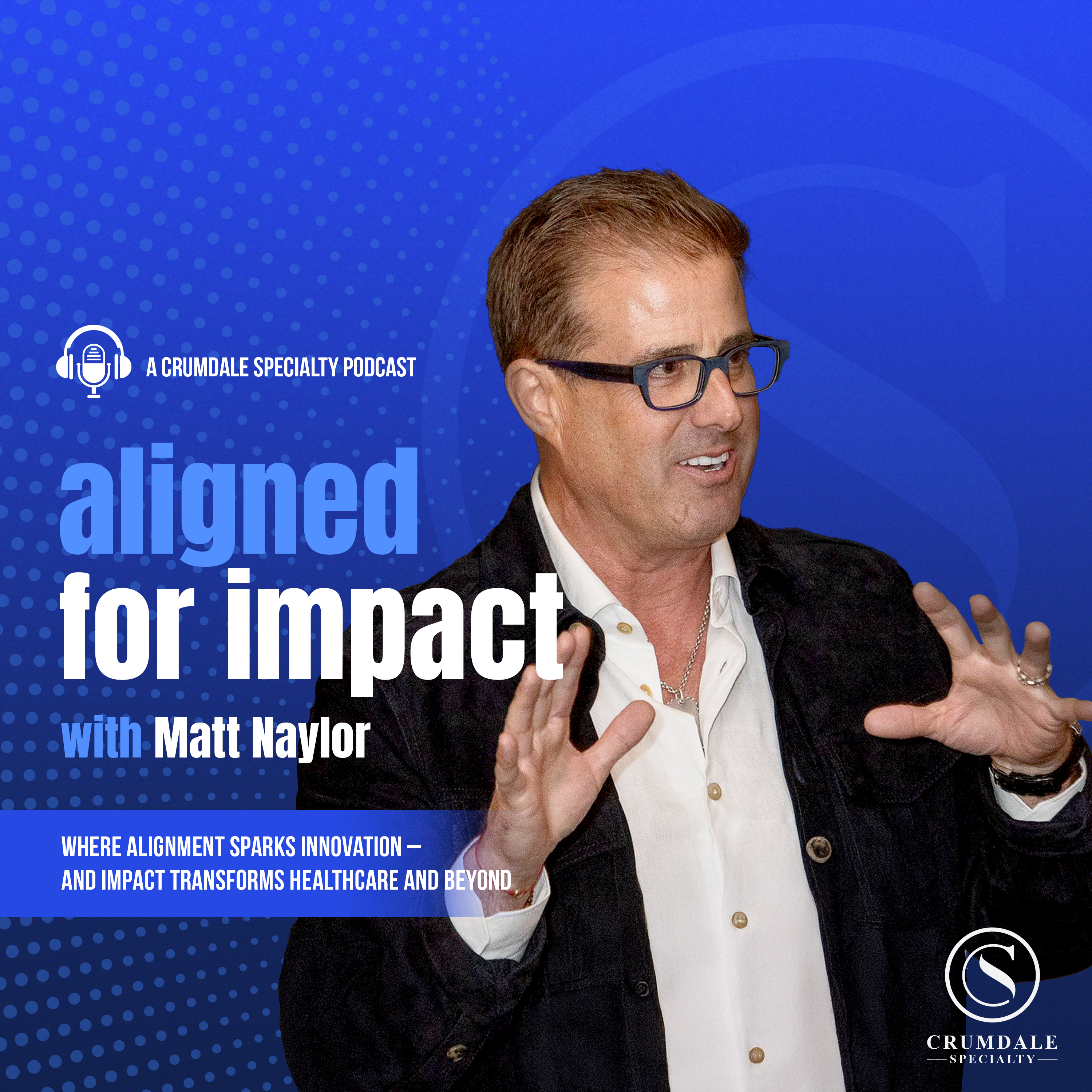
[00:00:02] Speaker A: Welcome to Alignment for Impact.
I'm your host, Matthew Naylor. I started this podcast because healthcare and leadership both come down to the same thing, alignment. When people, purpose and performance connect, real impact happens.
On this show, we'll talk with entrepreneurs, brokers and change makers who are challenging what is broken in healthcare and in business and find new ways to make a difference for companies, communities and the people they serve.
Welcome to the Matthew Naylor podcast where we discuss someone's passion, purpose, happiness and joy living a life of impact.
Today we're talking about Crumbdale Specialty where we partner with a unique set of brokers nationwide that are really, truly making a positive impact for their self insured clients, employers and their members, both large and small, where they're creating better outcomes, lowering cost and creating better experiences with real transparency for their clients. I'd like to welcome our guest, Kelly Brady from Accushure. Kelly, Accushure is an awesome, awesome business.
There's lots of great, great consulting and brokerage businesses all around the nation. Crumbdale Specialty is really about limited distribution, all focused on real alignment of interest. Where we find brokers that truly want to work hard, they want to do the right thing, they want to serve their customers the right way, they like doing it in a way that's truly transparent, where you can like really reduce the cost, produce a better outcome and create a better experience for a self insured employer. Whether it's a captive solution, it's a level funded solution, it's a PBM solution, it's compliance, it's stop loss.
And Accushure was one of our first partners.
I don't know if you knew that.
[00:02:10] Speaker B: I didn't know that.
[00:02:11] Speaker A: Yeah.
So when the business was originally started, one of their first acquisitions of an agency was here in Philadelphia and kind of slash New Jersey.
And it was an employee benefits business that we had a very long relationship with.
Can we just start by Kelly, could you. Getting in the insurance business is always interesting to me because nobody just, you know, everybody lands at it in some strange way.
[00:02:44] Speaker B: Right.
[00:02:45] Speaker A: Can you just tell us about yourself, like where you're from and how you got into the business? Sure.
[00:02:50] Speaker B: I'm from Wisconsin, near the Milwaukee area. Born and raised there, lived there my whole life.
I was working at a computer training facility. My Northwestern Mutual representative at the time said, hey, how's it going? I said, it's all right. Not sure I really like this. I, my wife had, I had just had our first son.
He said, well, I think there might be an opening here.
So what is it in it's employee benefits. I go, I don't know anything about employee benefits. Then all you should meet these guys.
So I met one of the greatest influences in my life, Richard Huck. Started a firm in Wisconsin with Northwestern Mutual. Worked there for 15 years.
Loved every minute of it.
About seven years ago, H and I, now Acrisure, came to me and said, hey, we'd like to interview you because there's some people that have been talking about you. I said, well, I'm going to go through this process because I don't know anybody at H and I or Acrisure. So I met with them and really it's been the best seven, seven and a half years of my life, personally and professionally. Feel like I've moved from more of a broker, last minute renewal type thing to now more of a consultant, advisor and partner with clients.
[00:04:02] Speaker A: Kelly, you just said something that I find very interesting.
Mentors can really have a positive impact on someone's life.
Can we just explore that a little bit? You mentioned Richard. Yeah. So how he really impacted you in a positive way.
[00:04:19] Speaker B: Yeah. So Richard and his partner at the time in the business, Bill Collins, Richard was probably the smartest guy ever met, knew everything there was to know. And Bill was just equally smart. But he was also a guy that just everybody remembered him. Even though I would work with the clients later, Bill was. People go, I remember Bill or I remember this. And so it's just that those two connecting that just really taught me about how to personalize things with people and not make this feel so transactional with them. And so there they've been big influences on my life. I still talk to Bill all the time. Richard has since passed away. But, you know, they were really big influences on my life. And then my other biggest mentor has probably been Mike Natalizio, who was the president of H and I really took me under his wing when I joined. Taught me really about going from again, insurance broker to a consultant and how to put the employee and employer first versus putting the insurance company first. So.
[00:05:19] Speaker A: Well, let's begin with help us understand what your role is at Accushure.
[00:05:23] Speaker B: Yeah, so my role originally was an account executive, renewals person.
And I went out on a number of those with some of our P and C producers and they said, you know, you did a great job on the renewal. What if you just come to a new business?
I don't really do new business. All I do is renewals. I said, no, no, we think you can do this.
So I went out and did that. And so I Kind of did probably 80% renewals and 20% new business. And then it started to shift more and they saw an excitement because they didn't need to know benefits, but they had the relationships and I didn't have to cold call. So it was a perfect marriage with one another. And on January of this year, I took on a role as an employee benefit consultant with accuracy. So now I'm trying to replicate what we did in Wisconsin throughout the Midwest and mentor young people like I was mentored by Richard and by Bill and by Mike Natalizio and give back to the younger people and have them be able to see and enjoy the passion excitement that I have every day with this.
[00:06:26] Speaker A: Well, that sounds like real impact, which is awesome.
Wisconsin in the Midwest. Could you tell us a little bit about the market, how and who's in the market?
[00:06:39] Speaker B: And so it's actually, it feels like there's two markets and they're 90 miles apart. So in the Milwaukee or greater metropolitan area, it's a lot of UnitedHealthcare, Blue Cross anthems, you know, the big carriers that you would think of. And then if you go 90 miles west, it's all HMOs in Madison. I mean, so it's totally different health care. So, Matthew, if you had a business in Milwaukee and you said, I'm going to move to Madison, your health care costs would probably go down a third and you'd get better plans. And you go, why is that? Well, because everybody in the Madison or Dane county area kind of likes those HMOs can only go to this one hospital. But in Milwaukee area, they all say, I want this hospital for my heart, this one for orthopedics, this one for. And. And so it's just a completely different model. And you feel like you're in two different states, but it's all in the same.
[00:07:27] Speaker A: And so one example, you're kind of referring to the Bookers.
[00:07:31] Speaker B: The book is correct.
[00:07:32] Speaker A: Blue Cross, the Aetna is the United States, the segments of the world, the big insurance providers of health care. And then.
And the other part of the market, you're talking about HMOs. Maybe the audience doesn't know exactly what an HMO is. So could you, could you explain?
[00:07:48] Speaker B: HMO is really where the insurance company and the providers are one. And so they're working together and they're saying, okay, we already know up front what the cost is going to be. This is what it. We're going to charge. And so it feels more attached or connected than maybe on the Buca Side, while the Bucas have the great resources and great help for people, it feels more personalized.
[00:08:12] Speaker A: Yeah.
And that's fine. I don't worry about it. The, the HMOs Kelly, really focus on like capitation.
[00:08:21] Speaker B: Correct.
[00:08:21] Speaker A: And limitation.
[00:08:22] Speaker B: That's correct.
[00:08:23] Speaker A: You know, when you think about network and access to care and so a lot less flexibility.
[00:08:29] Speaker B: A lot less flexibility. A lot less.
It's more of just like this is where you can go.
[00:08:35] Speaker A: Yeah.
[00:08:35] Speaker B: And again, the 90 mile difference is. So HMOs have tried to come into the Milwaukee area and people are like, no, no, no, I don't want primary care doctor referrals. I don't want to be told where I can go. And so it's just a different unique market.
And part of that is then you have the highest healthcare cost. So people look at that and go, how could you have the highest. Because you can go anywhere you want and to go anywhere you want, it costs more money.
[00:09:03] Speaker A: And Kelly, how are you and actually accu. Sure.
Helping your employers better leverage data so they can make smarter decisions.
[00:09:14] Speaker B: Yeah, great question. So I, I've primarily focused on groups that are fully insured or level funded. And I've really seen an explosion in this level funded over the last probably seven years since I joined Acrisure, where people are saying, yeah, this makes sense if I can get some information. Not to be punitive to, well, Matt, you use the insurance this way. But more of, hey, Matt, Your company's got 10er visits in the first quarter. Maybe this is an education opportunity. So we've tried to focus on educating and empowering people versus hey, you know, we'll wait till 60 days before the renewal and go, oh my gosh, you shouldn't have had people use health care wrong this last year. And it's not, again, not to be punitive, but to be educational and to be able to say, how can we control the costs? I would also say that there's a, especially in the last five years with COVID there's so many people switching from one job to the next. So you got people that were in large companies that said, I meet with my advisor quarterly, I look at all of our data, I'm using that data to have better outcomes. But now I work at a company that has 50 employees. Well, I want that same kind of card or a red carpet service. And that's where we're trying to focus on looking at different opportunities for people to have them.
[00:10:30] Speaker A: And Kelly, you know, there's lots in your market, it sounds like there's Lots of level funded options.
[00:10:36] Speaker B: Correct.
[00:10:36] Speaker A: With the carriers and others.
How from your perspective and experience is Crumbdale specialties level funded solution unique and different?
[00:10:50] Speaker B: It is very unique couple. Probably the biggest thing is that it works on the pharmacy, attacking the pharmacy. And that's the thing that's really been driving the cost here in Wisconsin especially in the last couple of years. You know two years ago I've told people I was questioned whether I'd have a job because groups were continuously getting 4050, 60, 70% increases. And when you would look at level funded data from a book I would say you had one Skyrizi, one Humira and the group would say well what am I going to do? Drop all my insurance because of one thing?
And they'd say well tell me again how come a self funded insurance, self insured company doesn't have this problem? Well they can work on the drugs and they can attack the cost of that. And they said well what's the options for us? Until I met Crumdale a couple of years ago there really wasn't an option for those smaller groups. I mean you could go to a captive but going to a captive meant you were really fully insured or completely self insured. And I think there were some scares to that. So there's some risk to that. Whereas this level funded with Crumbdale is really now that third step. I feel like you go fully insured, probably do a Buca level funded and now you're moving into this Crumbdale world. I would say there's a couple others like you, nobody that's really attacking the pharmacy like you are but I think about a client of mine, very dear client of mine, 20 years I've had worked with them. In 2022 they got an 8% increase from Abuka. Two months afterwards we could see in the level funded report they hired a person with Skyrizi. Two months later they hired another person that had Skyrizi. So now you have three people that have Skyrizi or and they had another person that took Humera so two Skyrizi's and a Humira and you knew that it was going to be a bad outcome. Sure enough the first renewal after that was 50%. Well they already have the highest deductible now they had the lowest contribution from the employer. There's nowhere to go.
And so I knew after that renewal in 23 that we had to start looking at things and we looked at ichras, we looked at peo look everything you can imagine. And Crumbdale came to us and said, well, we think we can move those 300,000 in drugs down to 60,000.
So. Well, I think you're crazy, but tell me how it's going to work. We met with our advisor from Cum Dale, Chuck Schultz, who I'd known for a number of years because he had been previously with Humana. He met with my client. I said to the client, you're my fa. You're one of my favorite clients. I've known you forever. This is a risk for us both, but this is probably the only thing you got left other than dropping insurance. And so we moved to it. And sure enough, Crumbdale's been able to exceed everybody's expectations over the last year with that.
[00:13:40] Speaker A: You know, I find it interesting that big insurance companies have all the same probably capabilities, but maybe not the same alignment. And at Crumbdale, it starts with building and designing really great solutions around, you know, a proper plan document, proper actual contracts, with all of the optimization of a self insured health plan. And we're talking about PBM services here in this most recent example.
But in this example of three very large pharmacy claims and costs spiraling out of control, and in that example, probably 80% of the cost coming from three people, you know, I was about maybe.
[00:14:25] Speaker B: Yeah, it was even more because we looked at it and there was only about in the whole group, there was probably 320,000 expend. And these three people were spending 300 of that.
[00:14:37] Speaker A: And so how did, how did Crumbdale intervene? In a way that was in the best interest of the employer.
[00:14:49] Speaker B: Right.
[00:14:50] Speaker A: And in the best interest of the member to not be invasive and disruptive.
[00:14:57] Speaker B: Yeah. So it started up front with our initial communications to employees that look, you need to see Crumdale as you see your actressure partners. We're here to help you with this. We're not here to tell you what you can and can't do, but we think if we can get you the same medication, your doctor will still give the prescription. It's just buying it a different way. And we think ultimately that will save you money and it will save your company money, which ultimately will reduce premiums going forward in the future as well on that. So that was the first part of it. And then soon as we were installed with Crumbdale, they already knew who the three people were based on some pre underwriting. And they reached out to those three people. Two of the people instantly were approved for bridge programs.
So the manufacturer's paying all that for those. And, and then the third one was Interesting, because the employee reached out and was like, hey, my drug's not covered. This Crumbdale is a bad thing. And so the owner called us and said, well, all right, well, let's call Crumbdale. We called our advocate at Crumdale and said, hey, Wendy, what's the problem here? Like, everything else is fine, but we got this one issue here. And she said, well, hold on, let me pull the report. So she pulled a report and she could see how many times they had reached out to the employee and he wasn't calling back.
And then we got on with the pharmacy consultant from Crumbdale. He said, I know what needs to be done. I just need this guy to call me back. So the owner told the employee he need to call back.
And the Crumbdale advocate had told us at the time, hey, I already knew that the issue, I knew what we were going to need because his co worker was on the same medication. And so I've already gone. I talked to the doctor. If I can just get this employee to call me, it'll be taken care of. And it ended up having to be international sourcing. It couldn't be a bridge because of income.
But my team didn't have to do a lot of extra work. The employer only had to tell the employee, hey, you need to call these people like we told you to call them.
And I just recently did a renewal with them in an employee meeting. And none of the employees reached up and said, hey, I don't like this. It's not working. They all said, this is great because now I'm not paying for the medication and employers win it.
[00:17:15] Speaker A: Kelly, you know, I've been an entrepreneur for longer than I like to describe, but 30 years. And I've invested in, owned and operated and started all my companies from scratch without outside capital. And you know, most of them at my kitchen table, you know, sitting, sitting right, you know, sitting right next to my, my, my wife. And health care is a really scary thing.
[00:17:39] Speaker B: Right.
[00:17:41] Speaker A: How do you take groups from fully insured, you know, to level, fund it with a lack of data. And I asked the question because I see so often brokers taking groups from fully insured, right to a captive solution that self funded with no data.
And as an entrepreneur, philosophically, I really have a, an issue with it.
[00:18:08] Speaker B: Right.
[00:18:08] Speaker A: You know, because it can cause like, it can cause real, a lot of heartburn, a lot of heart, cause real issues and significant financial damage if it's done wrong. So can you help us understand how you at accu? Sure. Take a Fully insured group to a level funded solution.
[00:18:24] Speaker B: So a lot of what it is is looking, you know, understand what the employer's goals are. What do you want to do? Well I often meet a lot of entrepreneurs like you. Hey, I've got five or six people I want to get to 10 or 20 or 30 or 50, whatever it is.
And I say well in the fully insured market you really have no idea what your costs are going to be. So if you matt have a company with five people now and you go hey, I just picked up a new client, need to hire 10 employees.
If you're fully insured and age rated, you have no idea what that's going to cost you. So you have no idea how to build that into your cost with your client. Whereas in level funded you're typically composite rated meaning all the singles have the same. So you know, I, if I need 10 employees I'm gonna pay 50% of it and it's 200 bucks that I cost me for employee. That's what I have to build into my client so you can build your business that way. The other is, is you're taking that fully insured where I have no control over it. I can't control my cost. I don't can't build in other benefits to my employees and say now in this level fund and I'll get some data that I can attack kind of like you would do on your business insurance. Hey, we have a lot of issues with our work comp mod. How do we adjust that? Well we have to look at what's causing the issues here. And so the level of funding gives you that mechanism to be able to start controlling that.
Once you then have some information on that, you can start thinking about how do I get to a captive or self funded and what would I do? Okay, well I'd make sure I have employee engagement, I make sure I have right pharmacy partners, I make sure I have the right network. And so you're just using that data to help you build your business.
[00:20:05] Speaker A: Kelly Our level funded solution is about optimization, supply chain management, total integration, vertically aligned so that we can drive to the lowest net cost, produce the best outcome, have all of the data at our fingertips so that we can create a great experience for the member.
We have a really phenomenal captive solution that we've taken a different approach to the market with. Like, you know, when I think about the market and other captive providers out there, they allow lots of choice when it comes to TPA services, networks point solution providers, cost containment.
So you could join a captive.
You could have 30, 40, 50, 100, 200 groups in a captive solution, all sharing financial risk together, but all having different cost containment, different administrators, different networks.
Tell us a little bit about Accushure's approach to the captive space specifically.
[00:21:17] Speaker B: Yeah, so we've primarily worked. I mean, we've looked at numerous captives, and I think to me it's more about where's the risk protection for an employer. You know, so there are certain captives that are really good for groups under 100, certain that are above that. A lot of my teammates, when it comes to groups over 100 and self funding, they're working on that. So I don't have a ton of experience on that, but it's always, to me about how to provide the most protection to an employer first and then be able to address that. And I think what you're starting to see with some, especially with the Crumbdale and with some of the others is these are good solutions for smaller groups. These are the kind that the CFO can sleep at night and the HR feels like, okay, this is an extra burden or work for me on those types of things.
[00:22:05] Speaker A: Crumbville is a unique and interesting business. You know, you've had this experience with us, but in your own words, why Crumbdale? Why partner with us when you have so many choices and so many options in the marketplace?
[00:22:22] Speaker B: I really feel like it's the personal attention. And so what I explain to people when I talk to them about Crumbdale is if you have a really high pharmacy issue, have somebody that can take care of that. And then if you have a really good service team, which we all do at all of our brokerage firms or firms throughout the country, that's great. But you need somebody that can really dive in and is invested in this. And that's what I see your advocacy team doing, is how can I really help Matt and his family with whatever health issues he has and that.
And. And while our team may want to do that, our team may not have the ability to do that because we have so many multiple clients. Whereas a crum nail can say, okay, we know what Matt's issue is. We're going to put one person on that, we're going to get it taken care of and get Matt to the finish line.
Makes Matt feel great, makes your employer feel great, makes us feel great, makes us all look really well with that. So I just feel like it's the personal attention to that, especially these groups that are smaller, you know, groups that are under 100, typically the HR is the same person that's accounting that does payroll. And so they're like, well, as much as I'd like to call a doctor's office to figure out why Matt's thing isn't covered or call the insurance company, I don't have time to do that because I got to do payroll. If I don't payroll then Jake's going to be mad because he didn't get paid this week. So it's just that personal attention. I like to say that basically your advocacy team is like your best client service team on steroids. You know we have at our firm, we, we just, we love our clients, we want to help them, but there's only so much time in the day and so many different avenues you can go to. And I think the other thing you run into is while we may have it at heart, providers won't listen to necessarily the brokerage firm or the advisor they will listen to, hey, you're the insurance company. Guys want to get paid. We're going to make this work so that Matt can get his medications or whatever.
[00:24:16] Speaker A: That Kelly Accujor is an awesome firm and we've had the pleasure of working with them now for 10 plus years. And in some parts of the country we're at centers of excellence for PBM Solutions where the average size customer is 3, 4, 5,000 employees.
Some parts of the firm were really a centers of excellence for stop loss.
Some areas of the country it's our captive solution, it's our level funded solution.
How has, you know, you've been in Accushure for seven years and you mentioned earlier on that it's been a hugely positive impact for you.
[00:24:58] Speaker B: Correct.
[00:25:00] Speaker A: Can you just explain a little more in detail how that's been the case?
[00:25:04] Speaker B: Yeah, and kind of a side note, my father was in charge of benefits for the city of Milwaukee for 25 years.
He did everything you could to build wellness and things like that. I remember when he retired how many people, even though the bells were on the eighth floor, wanted to walk to the eighth floor to ring the bells with him when he was retiring.
And I thought, man, this guy really made an impact on people's lives. And I didn't realize that as a kid, I didn't realize that as an adult.
So I wanted, I said to myself, when I leave I want to make sure that I'm making that kind of impact to him. And I really feel like with the Crumdale and some of the other and the level funded and the, the ways that we attack risk and Accuracy.
I feel like I'm making a difference. It's not a transactional thing. I never wanted to be in transactions. I wanted to be part of the relationship.
And I see so many opportunities right now in the country to help people improve their health care, to have this better experience with health care and to really take control of it.
For so long we've all been passive. Hey, my doctor told me to do this or my doctor told me to do that.
And so really just that's probably been a big influence to me. The other is seeing. And again, comparing. People have heard this all the time. The two greatest guys in my life were my father and my father in law. My dad worked for the city, as I mentioned. He knew everything about benefits. He was the best consumer. He got everything taken care of. He could help people. My father in law worked for a very large company. Every year they go, here's your packet. Figure out what you're doing for open enrollment. And he never knew what he was doing.
And he had diabetes, still has diabetes.
And he never used a flex until three years before he retired.
And one year he's like, what's this FSA thing? I don't understand this. Don't they talk about this? And he goes, no. He goes, I don't think I can afford to do it. I go, you're spending like $3,000 a year on your diabetes medication. You can't afford not to do this.
And so I see this passion and I have this passion of taking people like my father in law who just didn't have the knowledge. It wasn't a desire, but he didn't have the knowledge.
And doing and helping him to become like my dad, where he's a better consumer and things like that, you know, that to me is what drives me every day, is how do I get my father in law to be in the same position my dad is? And then the same thing with employees. How do you get an employee who normally goes, oh my gosh, here's this open enrollment. I don't know what to do to feel excited about this or to remember again, we talked about this earlier. Maybe the camera sees that, our tennis shoes, you know, how do I just remember the person that's going to help me when I have an issue? That crazy guy dresses really nice, but he wears tennis shoes. And, and that's what I want people to remember is there's somebody there to help you. And I now feel like we're getting to that point, especially with a crumb deal specialty where there's somebody else that can help beyond me. So if I can get them to me, they trust me, I can then get them to crumb to you who can solve the issue for them.
[00:28:13] Speaker A: Kelly, I've really enjoyed our conversation thoroughly. You're a phenomenal example of a person that's living a life of real passion and purpose and really cares about positive impact.
You and Accu sure have an awesome, awesome future, and we're very lucky and fortunate to have you as one of our unique partners. Appreciate it. Thanks for being here today.
[00:28:37] Speaker B: Thank you.
[00:28:38] Speaker A: Yeah, this is Matthew Naylor. You've been listening to Aligned for Impact.